Friday, October 07, 2011


Tuesday, March 22, 2011

Thursday, March 10, 2011

Tuesday, March 01, 2011
Edwin Booth's Apology to the American People

Sunday, August 01, 2010

Friday, March 12, 2010
Baby's First Book Signing

Went to a great library lecture at the U. Club last night on NYC during World War II.
Wednesday, January 20, 2010
Nevermore?
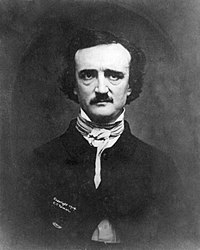 According to an article in today's NY Post, the mysterious stranger who would leave cognac & roses on the grave of Edgar Allen Poe on the author's birthday (January 19th) every year for 60 years failed to show this year. I hope he's OK, as this was a great literary tradition I would hate to see end.
Wednesday, August 19, 2009
"What Is A Man?"

A man carries cash. A man looks out for those around him — woman, friend, stranger. A man can cook eggs. A man can always find something good to watch on television. A man makes things — a rock wall, a table, the tuition money. Or he rebuilds — engines, watches, fortunes. He passes along expertise, one man to the next. Know-how survives him. This is immortality. A man can speak to dogs. A man fantasizes that kung fu lives deep inside him somewhere. A man knows how to sneak a look at cleavage and doesn't care if he gets busted once in a while. A man is good at his job. Not his work, not his avocation, not his hobby. Not his career. His job. It doesn't matter what his job is, because if a man doesn't like his job, he gets a new one.
A man can look you up and down and figure some things out. Before you say a word, he makes you. From your suitcase, from your watch, from your posture. A man infers.
A man owns up. That's why Mark McGwire is not a man. A man grasps his mistakes. He lays claim to who he is, and what he was, whether he likes them or not.
Some mistakes, though, he lets pass if no one notices. Like dropping the steak in the dirt.
A man loves the human body, the revelation of nakedness. He loves the sight of the pale breast, the physics of the human skeleton, the alternating current of the flesh. He is thrilled by the snatch, by the wrist, the sight of a bare shoulder. He likes the crease of a bent knee. When his woman bends to pick up her underwear, he feels that thrum that only a man can feel.
A man doesn't point out that he did the dishes.
A man looks out for children. Makes them stand behind him.
A man knows how to bust balls.
A man has had liquor enough in his life that he can order a drink without sounding breathless, clueless, or obtuse. When he doesn't want to think, he orders bourbon or something on tap.
Never the sauvignon blanc.
A man welcomes the coming of age. It frees him. It allows him to assume the upper hand and teaches him when to step aside.
Maybe he never has, and maybe he never will, but a man figures he can knock someone, somewhere, on his ass.
He does not rely on rationalizations or explanations. He doesn't winnow, winnow, winnow until truths can be humbly categorized, or intellectualized, until behavior can be written off with an explanation. He doesn't see himself lost in some great maw of humanity, some grand sweep. That's the liberal thread; it's why men won't line up as liberals.
A man gets the door. Without thinking.
He stops traffic when he must.
A man resists formulations, questions belief, embraces ambiguity without making a fetish out of it. A man revisits his beliefs. Continually. That's why men won't forever line up with conservatives, either.
A man knows his tools and how to use them — just the ones he needs. Knows which saw is for what, how to find the stud, when to use galvanized nails.
A miter saw, incidentally, is the kind that sits on a table, has a circular blade, and is used for cutting at precise angles. Very satisfying saw.
A man knows how to lose an afternoon. Drinking, playing Grand Theft Auto, driving aimlessly, shooting pool.
He knows how to lose a month, also.
A man listens, and that's how he argues. He crafts opinions. He can pound the table, take the floor. It's not that he must. It's that he can.
A man is comfortable being alone. Loves being alone, actually. He sleeps.
Or he stands watch. He interrupts trouble. This is the state policeman. This is the poet. Men, both of them.
A man loves driving alone most of all.
Style — a man has that. No matter how eccentric that style is, it is uncontrived. It's a set of rules.
He understands the basic mechanics of the planet. Or he can close one eye, look up at the sun, and tell you what time of day it is. Or where north is. He can tell you where you might find something to eat or where the fish run. He understands electricity or the internal-combustion engine, the mechanics of flight or how to figure a pitcher's ERA.
A man does not know everything. He doesn't try. He likes what other men know.
A man can tell you he was wrong. That he did wrong. That he planned to. He can tell you when he is lost. He can apologize, even if sometimes it's just to put an end to the bickering.
A man does not wither at the thought of dancing. But it is generally to be avoided.
A man watches. Sometimes he goes and sits at an auction knowing he won't spend a dime, witnessing the temptation and the maneuvering of others. Sometimes he stands on the street corner watching stuff. This is not about quietude so much as collection. It is not about meditation so much as considering. A man refracts his vision and gains acuity. This serves him in every way. No one taught him this — to be quiet, to cipher, to watch. In this way, in these moments, the man is like a zoo animal: both captive and free. You cannot take your eyes off a man when he is like that. You shouldn't. The hell if you know what he is thinking, who he is, or what he will do next.
Thursday, May 14, 2009
Mark Twain
 Was thinking about him today and would like everyone to spare a thought for him, as he is a primary personal hero of mine. A new book of previously unpublished writings was recently released called "Who Is Mark Twain?" and so it set me wondering. As the publisher Robert Miller correctly observed, "Twain's the grandfather of Stephen Colbert, Jon Stewart and Steve Martin. He has such a dry subversive wit that you feel like he's invented modern humor."
Wednesday, March 19, 2008
New Yorker Caption Contest
Since 1982 the English Department at San Jose State University has sponsored the Bulwer-Lytton Fiction Contest, a whimsical literary competition that challenges entrants to compose the opening sentence to the worst of all possible novels.
Edward Bulwer-Lytton was the author of that line, made famous by Snoopy of "Peanuts" fame, "It was a dark and stormy night..."
"It was a dark and stormy night; the rain fell in torrents--except at occasional intervals, when it was checked by a violent gust of wind which swept up the streets (for it is in London that our scene lies), rattling along the housetops, and fiercely agitating the scanty flame of the lamps that struggled against the darkness."
--Edward George Bulwer-Lytton, Paul Clifford (1830)
Dreadful. So they named a great contest after him to write a terrific / terrible opening line to a fictitious novel. Brilliant.My entry, nearly 20 years ago, was "The vultures alit from their prey, their carrion luggage stowed away." So I get a call from Christian telling me that this week's New Yorker Caption Contest is PERFECT for a joke I made 2 decades ago. Naturally, I submitted a similar entry thinking that - at last - my time had arrived, destiny had come calling, and I would finally get national New Yorker-level recognition for my rapier wit...
Here's where I get angry. Christian & I had superior entries for this week's Caption Contest, neither one of which was chosen. So, I took it up on myself to write our friend Bruce, who is a film critic and editor at the New Yorker:
Bruce:
I apologize in advance for this rant, but I am afraid that I am really furious at your employer. As you know, Christian & I are obsessed with the Caption Contest. Now, of course we always think our submissions are superior, but this week it's no contest whatsoever and we are really angry that the three that were chosen were INFINITELY inferior to our submissions.
Here is the cartoon, and the 3 loser entries:

 | ||||||||||||||||
| ||||||||||||||||
Now here are ours:
Mine -- "No, no checked luggage. All carrion."
Christian's -- "No, I said we should adopt a corporate culture."
Obviously ours are better.
So, in short and in closing, you work for a bunch of communist-sympathizing whoremongers who wouldn't know good cartoon captions if they bit them in their pompous asses. Filthy animals...
Strong letter to follow,
LTG


